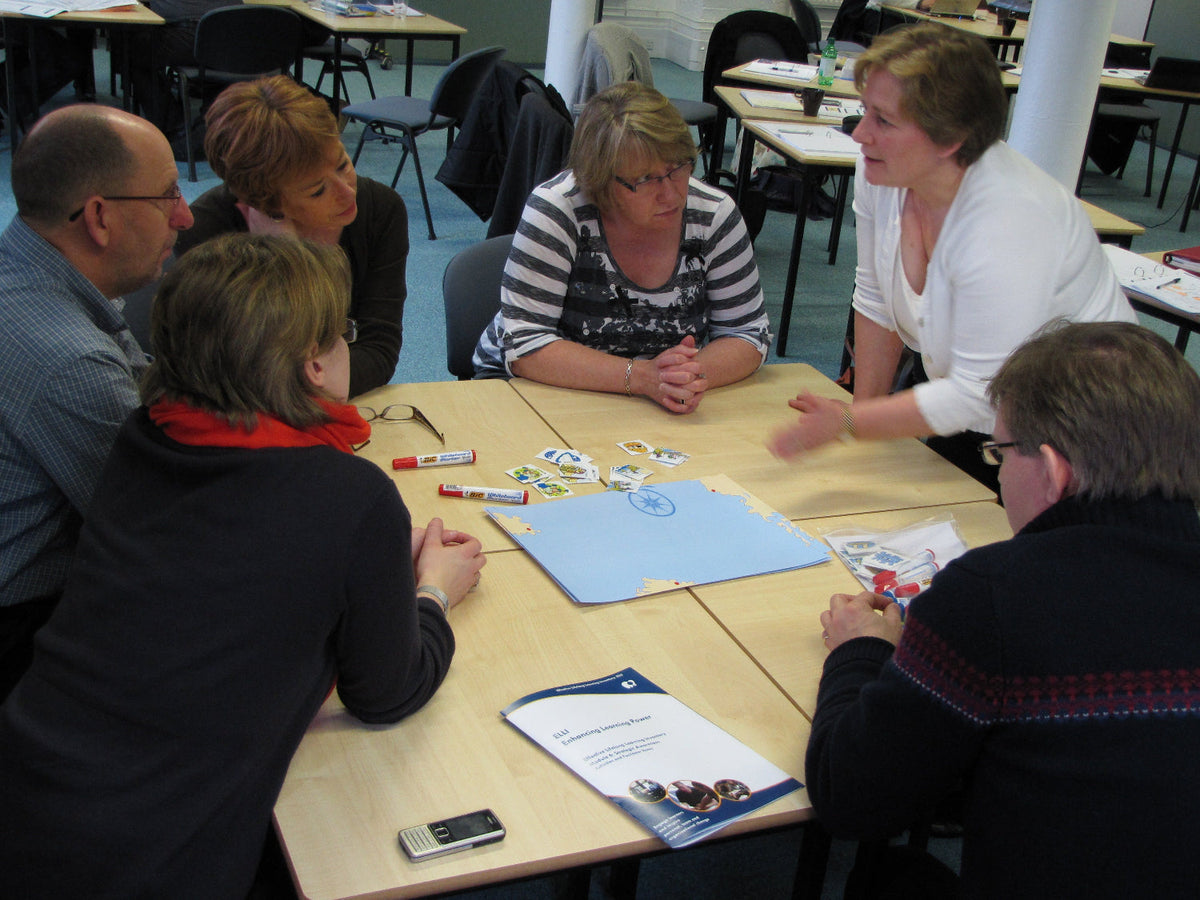
This series of articles has been stimulated by Harvard Professor Amy Edmondson's book 'Right Kind of Wrong' which won the 2023 Financial Times Schroeders Business Book of the Year. One of the key take-aways from this excellent book is the need to create a climate of psychological safety within a team if they are to recognise and leverage the potential relationships between risk taking, learning and growth. Please excuse me if I sound a little smug here, but knowing how to encourage this climate within a learning environment has always been an essential part of every experiential facilitators' toolkit. It's no surprise that Amy recognised this when she used RSVP Design's learning tool Electric Maze (now EM4) to generate data for her book - you simply can't get the best out of experiential tools if you don't first take some time to build the sense of safety for the team.
So how would we recognise a team working environment that has psychological safety? Amy describes it as “a workplace where one feels that one’s voice is welcome with bad news, questions, concerns, half-baked ideas and even mistakes. People should feel like they can ask questions, raise concerns and pitch ideas without undue repercussions." It's a hugely valuable thing to have, A 2017 Gallup found that if organisations increase psychological safety, it makes employees more engaged in their work and can lead to a 12% increase in productivity. In 2015, when Google studied its employees to determine “what makes a good team,” researchers found that psychological safety was the most important quality that determined a team’s success.
Building psychological safety in a given team isn't an instant fix, it takes time, sensitivity and persistence. Here are a few principles that might help;
- Ensuring everybody is aware of the team's purpose - and has bought into it.
- Ensuring that this purpose if consistent with team and individual values, so that nobody has a sense of discomfort about what they are expected to be doing.
- Ensuring that people feel that it's OK to speak up if the team is going in a direction that is contrary to their values, or if an individual feels pressured to do something they don't agree with.
- Building an understanding of the difference between behaviour and identity so that voicing a concern about what somebody is doing is not viewed as a comment on who they are.
- Making review of performance and offering feedback is a routine, everyday part of the way that the team works rather than an exceptional, formal, and often feared occurence.
Once again these are principles that are more easily built in an experiential learning environment - it's much less threatening to consider how an individual's behaviour led to a better or worse result in a 'game' than it would be to ask the same questions in relation to workplace behaviour. I've found that activities such a Colourblind, Simbols and T-trade offer a wealth of opportunities to gently link behaviour to outcome and to consider alternative ways to contribute to the team performance.