

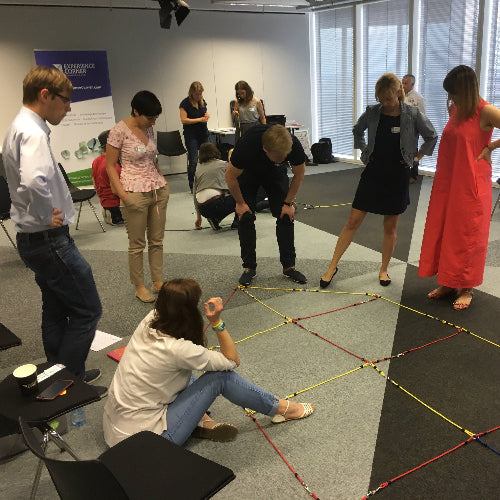
Webmaster® is one of our bigger activities, easily keeping groups of 10 - 30 people engaged. It comes ready to be used in a single group or multi-group format depending on desired learning outcomes - but this scaleability is just one variable in possible uses for what is perhaps our most versatile single tool.
One of my favourite bits of programing that uses Webmaster is in exploring the idea of contribution. Starting in three discrete groups the first phase of the activity can be made to examine individual contribution - "You started the action with one or two pieces of the construction in your hand - how did you decide how best to make your contribution?" The action then brings the three groups together but maintains their discrete identities - "How did your contribution change when this happened? Did it make it easier or harder to contribute?" Finally the team boundaries dissolve and it's one large organization - "What did you need to do differently? Which phase did you find easiest / most enjoyable?" Extending the answers to these review questions can go a long way to helping teams and particularly individuals determine their place in an organization.
In the previous article I've already used Colourblind® as an example of an activity that can be used to look at integration, and Webmaster® is another way to address this learning outcome. Allowing each of the three teams the independence to evolve their own ways of working, terminology and role allocations develops three working cultures, each of which has proven successful. When we bring the teams together and ask them to work as a single organization it sets up the need for them to establish common ground; sometimes this is a direct lift from one team which is perhaps stronger or more vociferous, sometimes it requires communication and negotiation. Either way it supports great learning from the subsequent review. If this is one of your most important desired learning outcomes then it may be worth using Colourblind and Webmaster in tandem - looking to apply the learning from whichever one you use first into the engagement with the second.
One final suggestion (all I've got room for in this article but certainly not the end of what's possible using Webmaster) is to focus the attention of the group on different styles of leadership. As Webmaster is another example of an exercise designed to utilise the principle of distributed cognition, the first phase of the activity is likely to default to a distributed pattern of leadership. Later we are likely to see those individuals who have a strong sense of the construction patterns emerging, to demonstrate a measure of expert leadership to get their ideas adopted as the team's way of working. The final phase, when two or three teams have to work together, needs the organizational capacity of a more traditional hierarchical leadership - though how this hierarchy is established is always interesting. This evolution of leadership lends itself to a chronological review - "How would you describe the group's leadership in the first 10 minutes?" "How did this change later?" "How effective was the leadership at these different stages?"
As I've said, there's a lot you can do with Webmaster if you think beyond simply using it as a 'team-building tool'.


