

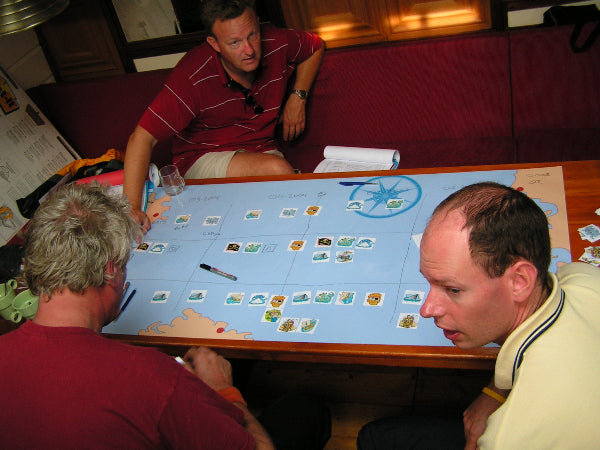
RSVP Design's Voyage Mapping activity is a different sort of tool to the ones I've featured so far in this series of articles. It's designed as a reflection tool that facilitates either planning activity or review-based activity. Simply put you can use it in advance of an action phase (either in a learning environment or in planning a real-world project); or you can use it after the action phase to review and evaluate what you've done. It lends itself in both use-cases to either individual work or group based work. If, in these articles, we're considering how to get full value out of an investment in experiential learning tools, this one couldn't recommend itself more, in that it can be used as many times as you need it, even with the same group, as they are creating their own material every time.
Stepping away from the typical ways of using Voyage Mapping we can suggest that it makes a powerful individual coaching tool. Having the client graphically explore the detail of their past experiences allows otherwise unseen patterns to emerge (e.g. how many times have your efforts been hi-jacked by critical pirates?) while shifting to planning mode, using the same tool, allows the client to move forward in a more informed way (what steps do we need to put in place to repel the pirates when they appear?). Photographing the completed Voyage Map means that it can be revisited at a future date to determine success and progress.
A group-based review after the delivery of a significant piece of work always runs the risk of becoming group-speak. It could be that one or more individuals feel very different about how it went, to what is recorded as the group concensus. Having each individual work independently to create their own Voyage Map looking back at the project is far more likely to illustrate differences in opinion. I've had great success in creating an art gallery of individuals' Voyage Maps and inviting the whole team (and sometimes outsiders such as senior leaders or suppliers) to a 'viewing' where team members can answer questions about their maps. What results is a much more candid, and potentially accurate, assessment of the project, and the way the team worked to deliver it.
Some of the most boring meetings in the corporate calendar can be made less tedious by introducing Voyage Mapping as a preliminary - not an icebreaker to sweeten the experience, but a contributory stage in the process. Some time ago we facilitated the finance leadership of a major multinational through the first stage of their financial planning using Voyage Mapping. With a shared start point - 'where we are today' and an agreed set of hard targets - 'destination island' we worked with the group to map the voyage they anticipated would join the two. They anticipated periods of steady progress, and times which they thought would be hard; they annotated the map with known and anticipated threats (pirates, sea monsters, fog, whirlpools etc) so that what they had was an entertaining, but deeply considered work of art. We left them at that point with the Voyage Map to guide them through the work of adding the detail and numbers that were needed for the draft financial plan. We have to say that we were flattered when that draft plan included a copy of the Voyage Map, the team felt it had been so important to their process.
Just three possible uses for the versatile Voyage Mapping activity - I could keep going for a long time with others I've experienced and heard about. Why don't you try the activity for yourself and realise what amazing value it represents.


