

Case Studies

Use of Dialoogle Product
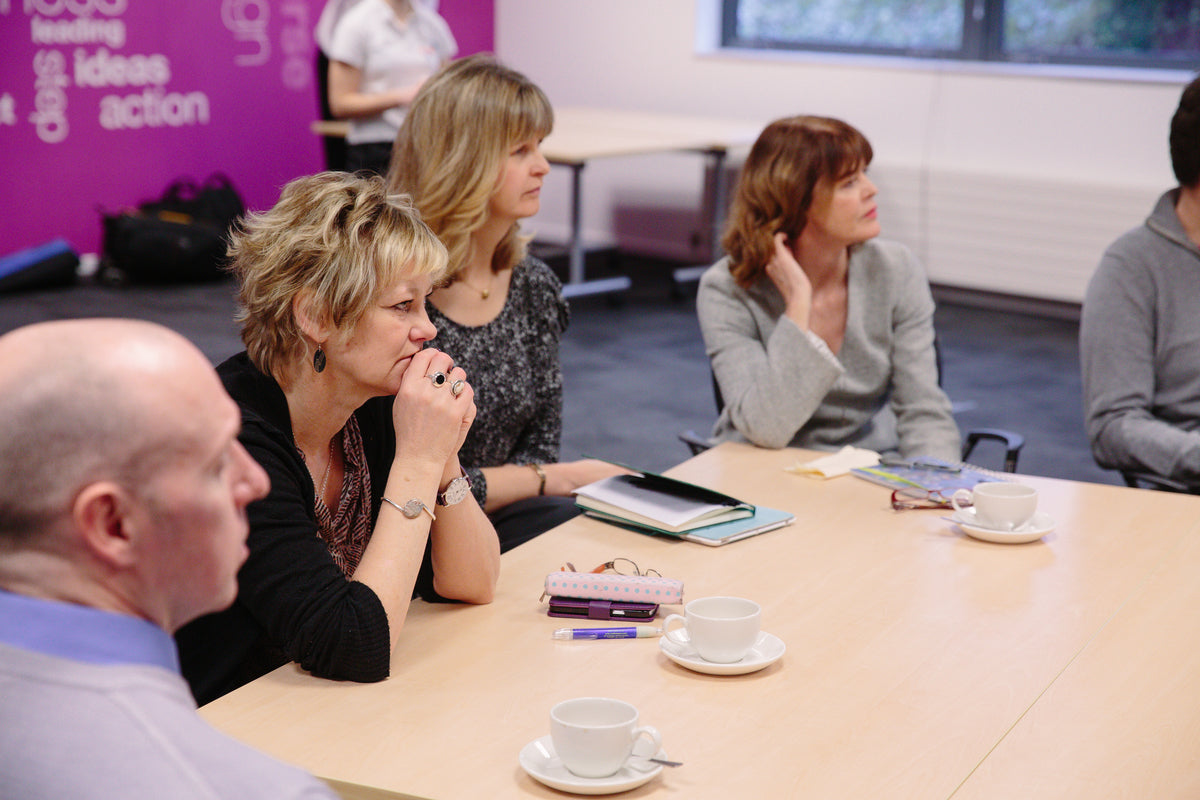
DIALOOGLE – Dialoogle cards are a carefully created and selected set of abstract images, photos, and symbols to creatively kick-start, renew, diversify, and qualify group discussions and conversations to enable participants to ‘open up’ about their thoughts and ideas in a safe environment. Outlined below is a description of how this image-based experiential activity was used as part of an internal leadership programme during a session on high performing teams to allow groups to visually create a future vision of the team and a bold statement to capture it. This case study is provided City of Glasgow College and is based on an event organized for more than 100 college managers that came together. Subsequently several managers have now approached the Organisational Development function about using the cards with their teams. There were a number of newly appointed as well as some established managers from across the college representing not only the faculty areas but also the support directorate Here is the explanation of how Dialoogle activity was introduced: Team Vision Exercise For the purpose of this exercise you are part of a new management team. Imagine it is 5 years from now and the team is being recognised for making a game-changing contribution. Step One From the images on the table select one image to represent each of the following: The way the team works together What it feels like to work as part of this team What others e.g. senior management/students/stakeholders are saying about us Once everyone has selected an image to represent the points above each person is invited to share their chosen image and explain the reason for selection Step Two As a team distil the range selected down to one or two images for each point to create a collective representation of the team vision. Final Step Create a bold statement of the desired future e.g. “This team will be known for...” Feedback from Douglas Alexander, Organisational Development Manager “Dialoogle cards provided great feedback, but furthermore these image cards turned out to be a great tool that could also be used in the future. A week after the event there were managers asking for sets of Dialoogle cards to use in their team meeting. These provided an opportunity for everyone to speak up. Not only was the manager talking, but all the team is involved and everyone has a chance to express themselves. The engagement from everyone is the same. Of course, more vocal members speak up first, but passive ones also have the opportunity to talk.Images help, as a picture speaks a thousand words. This activity has also proved useful with multicultural teams where language may be a barrier and even when a translator is used, the images still provide the depth for the conversation. Images encourages sharing in an open and honest environment.” Further Information To learn more about how we can help you to integrate or facilitate powerful, experiential learning activities in your training, please contact sales@rsvpdesign.co.uk or call +44 141 561 0387
Read more

Bahrain Polytechnic
Bahrain Polytechnic: A Case Study in the application of RSVP Design learning tools Bahrain Polytechnic is a government-owned tertiary education institute located in the Kingdom of Bahrain, teaching local students on a range of degree courses including Business, Information and Communications Technology, Engineering Technology, Visual Design and International Logistics Management. With an intake of approximately 300-400 students each academic year, the Polytechnic is small enough to offer a student-centred approach to learning and a high level of support to students who are struggling. A foundation year, ‘Preparation for Academic Learning’ offers additional teaching and coaching in core subjects of English and Maths and provides an opportunity to enhance study skills. There is also time to develop inter-personal, communication and team-working skills. A range of ‘electives’ – additional programmes which students select themselves – operates alongside the main academic programme. Integrating RSVP Design’s experiential learning tools The Polytechnic is committed to developing what the staff refer to as “21st Century Skills” – the skills that support independent learning, creativity and innovation, communication, the acceptance of individual responsibility and effective teamwork. They understand that in a small island, local students need to be prepared for employment outside their home environment and will benefit from developing a broad range of skills that make them attractive as employees in international businesses. In 2013 The School of Humanities bought a full range of RSVP Design’s experiential learning tools, specifically in order to develop an elective entitled ‘Thinking out of the Box’. This programme ran for the first time in the academic year 2013-2014 and received overwhelmingly positive feedback from the students. The programme includes 60 hours of classroom based study, plus 90 hours of self directed work including in-depth, reflective assessments, and aims to give students a very different experience of learning. RSVP Design’s selected learning tools A number of key activities from the RSVP Design range punctuate the programme. The ‘Challenging Assumptions Puzzle’ challenges students to ask questions, challenge what they think they know and leave behind beliefs that will limit their academic progress Colourblind® rehearses and refines verbal communication skills and group problem-solving Counter Intelligence highlights the importance of applying critical thinking skills, emphasizing the need to evaluate and seek evidence in an age of freely available ‘mass information’ Webmaster offers a challenging, large group application activity towards the end of the programme, which assesses the students’ ability to manage time, resources and each other in delivering a complex project with a measurable correct answer, under test conditions. Examples of Student Feedback I realised in this course that I am resourceful and I can adapt to change even though my perspective at that start was that was not possible. I had no idea what I could be capable of doing especially in group. Dealing with difference, was very significant for me. I was exposed to students from other degrees and I have encountered that before. I realised that I can cope with uncertainty, I did not know this about myself. I realise that I had a perspective that I now believe was “wrong”. I saw that everyone in our team offered something. That having a shared goal and a commitment together makes a big difference,. I felt proud, not a feeling I was used to having here. I saw how well groups can work!! I had never had that experience before. In life I limited myself too much... my perspective of myself has changed. I was never confident walking into uncertainty. I avoided uncertainty. But this course showed me that I can cope with uncertainty and that if I just “go there “then great things happen. I realise I have a quiet confidence that I developed throughout the course. I realise I do not give up even though I had a perception that I do. I realise I like hands on I didn’t know this about myself and I am thinking I want to use this more in my life. I loved the course because it was so different from anything I had done before. It gave me an opportunity to learn more about myself. I realised that I do not like being responsible for others but in the course I had to address this. I had to be involved. I cannot believe it: I actually love the new things. RSVP Design’s Training of Trainers The elective programme has been so successful, and student feedback so encouraging, that Bahrain Polytechnic has confirmed its commitment to developing a more learner-centred, experiential learning approach across all of its programmes, beginning in the Faculty of Humanities. To support and accelerate this, Ann Alder from RSVP Design was approached to deliver a two-day workshop training to the Faculty Management Team, including programme managers and designers and lead teaching staff. The workshop, for 16 people, covered many aspects of the design and delivery of experiential learning activities and was tailored specifically to the skills and needs of the Polytechnic. This was followed by a one-day workshop which was extended out to 40 teaching staff, from a range of specialisms including Maths, English, IT, Engineering, Visual Design and Transport Logistics. This workshop introduced the concept of REALs – Rich Environments for Active Learning – and explored how to use experiential and accelerated learning techniques in teaching more technical subject matter. Feedback and testimonials “I have had the most wonderful two days of training that I have had in 40 years of working in education. I have to say, I have enjoyed this more, and learnt more, than in anything else I have done at the Polytechnic. And Ann Alder, is without doubt, the best facilitator of learning I have ever met.” Sajida Tabbara, Dean of the School of Humanities, Bahrain Polytechnic “Creating and delivering the ‘Thinking out of the Box’ elective has been a wonderful experience. The staff are motivated, excited and our enthusiasm is transferring to the students. Student feedback is outstanding – they are thinking about themselves, reflecting and producing assessment work that demonstrates a level of personal awareness and maturity that we never expected.” Jo Visser, Annie Roberts and Deborah Brownlie, Course Tutors Further Information To learn more about how we can help you to integrate or facilitate powerful, experiential learning activities in your training, please contact sales@rsvpdesign.co.uk or call +44 141 561 0387
Read more
Guilford County Schools, Greensboro, North Carolina, USA
GCS is the third-largest district in North Carolina, serving more than 72,300 students across 127 schools in urban, suburban and rural areas. The district is divided into four regions, each with its own regional superintendent, office and support staff to provide personal attention to our schools. Because it is a larger district, GCS are able to offer opportunities that smaller districts, charter and private schools just can't. They have 47 magnet and choice schools with 54 programs, from Science, Technology, Engineering and Math (STEM) to performing or visual arts, advanced academics, Spanish immersion, Montessori, health sciences or aviation. They also offer 192 Career and Technical Education courses in 50 schools, including programs in culinary arts, business, nursing, computers and automotive technology, among others. High schools across GCS offer more than 29 Advanced Placement courses. These college-level classes prepare students for the higher-level courses they will take after graduating from high school and moving on to colleges and universities. GCS also offers the prestigious International Baccalaureate program at four high schools - and it's open to all students who qualify. Only a small number of districts in North Carolina are authorized by the International Baccalaureate Organization to offer the Diploma Programme, and GCS has been a part of it since 1996. Personalizing learning is a key value, and GCS are committed to personalizing learning for each of their students. The Strategic Plan 2016: Achieving Educational Excellence: Personalizing Learning focuses on reaching each student at his or her academic or interest level, then providing the tools to move them ahead. Coaching School Principals, Teacher Leaders and New Teachers GCS has a dedicated team of 13 within their Talent Development Centre, providing coaching support and on-going professional training to educators in schools. RSVP Design were asked to work with this team to help them to prepare professional development programs to be run as summer retreats in 2015, for three groups: 120 Teacher Leaders, 50 School Principals and 40 newly recruited teachers. GCS had already invested in a wide range of RSVP Design’s experiential learning tools and wanted to ensure that they made the best use possible of these exciting resources. RSVP Design’s involvement in the Program Ann Alder, RSVP Design’s specialist in the training of trainers and teachers, was invited to work with the team over 4 days. Part 1: Learning Objectives (2 days) To develop a consistent understanding of the principles that underpin experiential learning, in order to create confidence in choosing and using experiential learning activities within development programs To explore a range of methods of selecting, running and de-briefing experiential activities in order to achieve specific learning objectives To gain in-depth understanding of the available RSVP Design activities and to practice using them in different ways and in different contexts To understand how to apply learning from the activities in other contexts and environments Learning Objectives (2 days) To establish clearly defined learning objectives and outcomes for two x 3-day retreats To co-create programme outlines which will integrate experiential activities into strategic discussions and planning workshops To consider how to facilitate these retreats, in order to achieve benefits for all of the participants The integration of RSVP Design’s resources and skills It was clear, initially, that the focus of this 4 day event was on a transfer of training expertise from RSVP Design to the GCS education team, so that they could apply it in their program design. What was unexpected was the extent to which the event also became an intense team development experience for those involved, addressing issues of trust, teamwork, knowledge-sharing, strategic planning and leadership. Ann believes firmly that the best way to discover the power and potential of the learning tools is by experiencing them first hand. As the team members worked through the activities, then reviewed their own learning, patterns of behavior began to emerge that they recognized from their day-to-day working relationships and systems. Some of these were positive and productive and some were less useful. The development planning that the team undertook during the program, and have committed to continuing after the event, was a major and surprising extra benefit from the training The RSVP Design content Day 1 was an introduction to the underpinning theory behind RSVP Design’s work: the models, theoretical frameworks and principles of learning design that we use to ensure learner engagement and powerful learning that will be retained and applied. This was done through practical experience, eg. introducing ideas about ‘the learning process’ through the experience and debrief of Challenging Assumptions, a puzzle that requires many assumptions to be explored as ‘old learning’ is put aside and new solutions developed. Colourblind® - a team exercise in achieving common meaning through the use of verbal communication - allowed the participants to become more aware of how the activity and debrief can be used to draw out multiple learning points and how important it is to have clearly defined learning objectives to keep both the trainer and learners focused on their specific learning needs. In order to demonstrate the need to apply learning from one context into a similar but more challenging one, the participants moved on to the Simbols activity. Working as sub-teams, they applied the speaking and listening skills, and use of language to achieve shared meaning, that they had learned in Colourblind®. They added in the requirement to develop an operational plan, under tight time constraints and to ensure that every individual was well briefed. The team’s failure to meet the time deadline illustrated a development need that they recognised and led to an exploration of the nature of leadership in different contexts. Learning from this exercise was applied in Minefield, which has the added advantage of introducing issues of competition and collaboration. Day 2 continued to focus on selected RSVP Design tools and as new activities were introduced, their potential for sensitising learners to important issues and providing them with a safe practice ground to rehearse and refine specific skills became more obvious. For example, whilst half the team worked on Sequencer as an exercise in project planning and time management (which brought to light many of the team’s own ineffective patterns!) the other half of the team acted as 1:1 observers. Following the general review of the activity, the observers met with their partners to provide a structured session of feedback and peer coaching, based upon their observations of input, contribution and effectiveness during the activity. This served two purposes, developing observation and feedback skills as well as demonstrating how a practical task can be used to generate personalized learning. As they worked through their chosen exercises, Ann introduced a wide range of different techniques for debriefing and drawing our individual and group learning. These included visual resources such as picture cards, kinaesthetic techniques such as group lineouts and description of emotional responses and activities such as grafitti sheets and post-it exercises to ensure maximum participation. Examples of structured learning review and future planning tools such as the Voyage Mapping facilitation tool were also explored. Throughout the 2 days, as the participants explored their resources and ways of applying them, they were able to begin to visualise how they could be integrated into the different tea RSVP Design’s facilitation support Days 3 and 4 of the programme were used to work in small groups to plan the three separate teacher retreats. Ann offered a design framework which all three groups adopted and then allowed them to work independently, responding to questions, coaching and suggesting possible input as required. The atmosphere buzzed: ideas were developed, improved and gradually three exciting and challenging programme designs emerged. Each one followed the principles of good learning design and each one was tailored to the very different needs of the three participant groups. For the School Principals, a programme developed exploring how they could use the very simple Action Centred Leadership model to balance the leadership demands made upon them in challenging school environments. For the Teacher Leaders, who face significant change in their role and relationships, a programme was devised using the Voyage Mapping metaphor and movie-making to action plan for the year ahead. And for the new teachers, experiential activities were designed into two important strands: a) managing themselves and their ongoing learning whilst experiencing the pressures and stresses of a new job and b) using their creativity to ensure that they offer engaging, challenging and interactive experiences to the children in their care. Feedback from the program “Our team had the opportunity to spend four days with Ann Alder, learning how to maximize our usage of numerous RSVP tools. Ann was amazing! Not only did we learn how to facilitate the RSVP tools, the experience changed the way our team will interact, communicate, plan, and design adult learning experiences forevermore. The learning tools were so well designed and easy to use. They are far more versatile than we ever imagined and it was Ann’s training that allowed us to realize how many applications each of them offer. Some of our favorites were Sequencer, Simmetrics, Minefield and Colorblind. Our only regret is that we did not work with Ann sooner!” Amy Holcombe, Ph.D. Executive Director of Talent Development, Human Resources, GCS Further Information To learn more about how we can help you to integrate or facilitate powerful, experiential learning activities in your training, please contact sales@rsvpdesign.co.uk or call +44 141 561 0387
Read more